Von dem Fischer un syner Fru
Runge’s fairy tales · Audio story in Low German
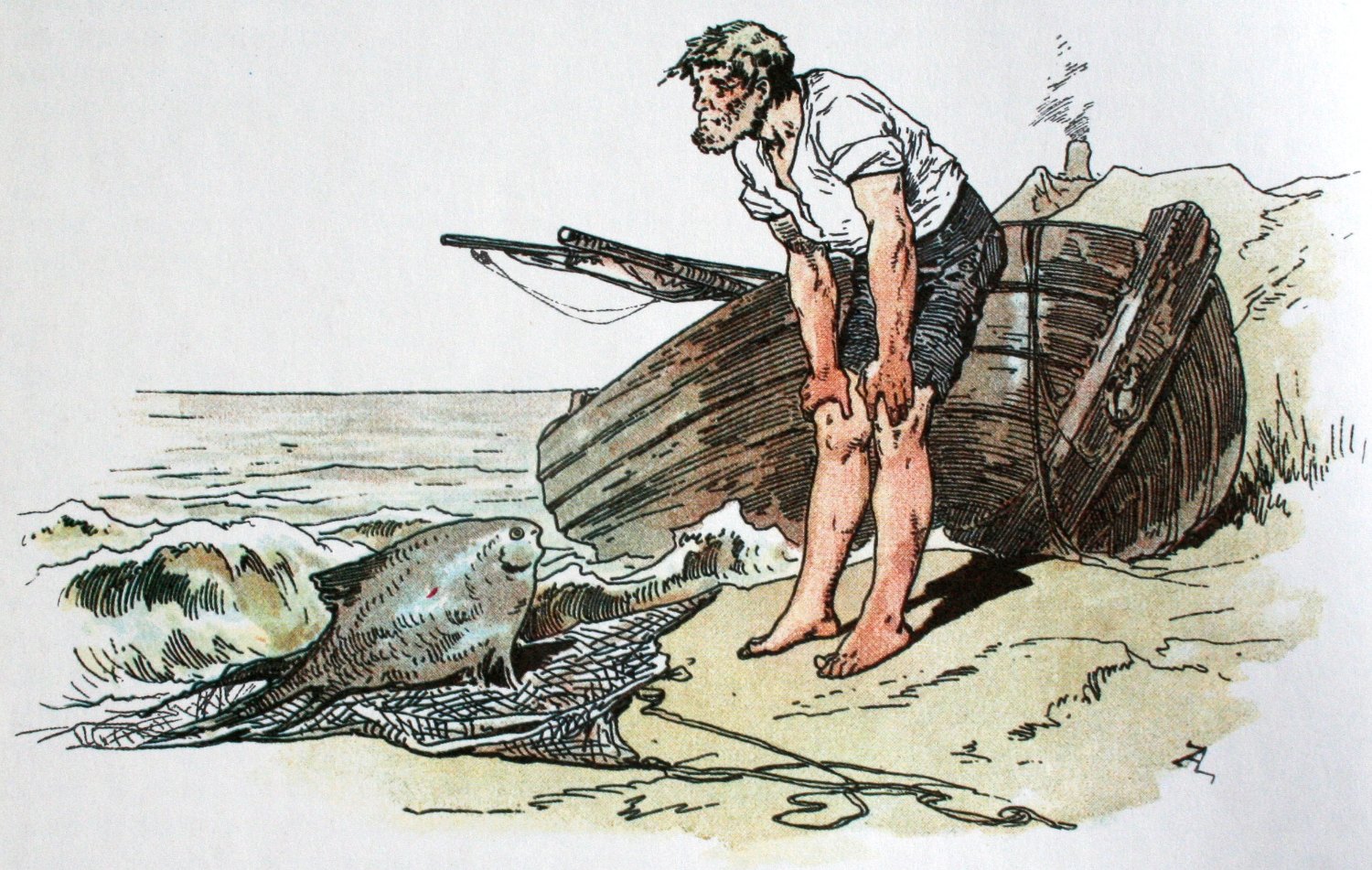
In 1806 Philipp Otto Runge wrote down this fairy tale in Low German, just as it was told in his Pomeranian homeland. The Brothers Grimm made it famous around the world as “The Fisherman and His Wife”. Here you can hear it again in its own language, told by Dr. Barbara Roggow, with harp music by Markus Thalheimer.
Listen
Manntje, Manntje, Timpe Te,
Buttje, Buttje in der See,
myne Fru de Ilsebill
will nich so as ik wol will.
Little man, little man, Timpe Te, / flounder, flounder in the sea, / my wife, Ilsebill, / won’t do as I would have her do. (free translation)
- Narrator
- Dr. Barbara Roggow
- Harp
- Markus Thalheimer
- Language
- Low German (Plattdeutsch)
- Length
- about 19 minutes
What it is about
A poor fisherman catches a flounder that can talk, and lets it go again. His wife Ilsebill sends him back to the water: the flounder is to grant her a wish. The hovel becomes a house, then a castle, then she becomes king, emperor and pope. With every wish the sea grows darker and rougher. When Ilsebill finally wants to be like God, the two of them are sitting in their old hovel again.
The narrator: Dr. Barbara Roggow
Barbara Roggow shaped Wolgast’s museums for decades. She studied museology in Leipzig, was head of the museum in Wolgast until 1987 and directed the Wolgast museums from 1995 to 2019 – the Town History Museum, Runge’s birthplace, the railway ferry and the Chapel of St. Gertrude. Together with the town she founded Runge’s own museum, which opened in 1997. For Runge’s 240th birthday in 2017 the house received a new permanent exhibition under her direction: Runge’s life downstairs, upstairs his colour theory, “We Three”, his fairy tales and paper cuts.
In 2018 she received the Culture Prize of the Town of Wolgast. With this recording she gives Runge’s fairy tale back to Wolgast – in the language in which he wrote it down. The redesign of the Rungehaus for the anniversary year 2027 builds on the foundation she laid.
„Das Haus ist der museale Gegenstand und das zeigen wir.“
“The house itself is the museum object, and that is what we show.” Barbara Roggow on the reopening of the Rungehaus, July 2017
The music: Markus Thalheimer

Markus Thalheimer is principal harpist of the Neue Lausitzer Philharmonie in Görlitz and founded the Görlitz Harp Master Class in 2021. He studied at the University of Music Würzburg. For this audio story he recorded the harp music that accompanies Barbara Roggow’s telling.
Runge and the fairy tale
- 1806
- Runge writes the fairy tale down in Low German and sends it with a letter dated 24 January to the publisher Johann Georg Zimmer. He sets the story on the coast near Wolgast.
- 1808
- Through the circle around Achim von Arnim the manuscript reaches the Brothers Grimm; Wilhelm Grimm makes a copy.
- 1812
- The Grimms print the tale as No. 19 of their “Children’s and Household Tales”. From there it travels around the world.
Runge recorded two fairy tales: this one and “Von dem Machandelboom” (The Juniper Tree). He did not invent them – he wrote down what people told, and gave them his own language.
Runge’s fairy talesThe Rungehaus
Verse after the Grimm version “Von dem Fischer un syner Fru”; English rendering of the verse is a free translation. Quotation from Barbara Roggow after dpa, 21 July 2017.